2025 was a tumultuous year for clean energy policy. Despite short-term challenges, thanks to collective efforts over the past several years, carbon management technologies now have a clear runway for deployment. Domestic projects are moving forward and advancing toward final investment decisions. Project developers are securing Class VI wells; the number of states with primary enforcement authority over Class VI wells now totals six, and the pipeline of announced domestic projects continues to grow – now totaling 32 operational projects and 288 announced projects across all phases of development. Globally, the pace of progress remains impressive, and we can learn valuable lessons from states, countries, and regions worldwide on effective policies that drive deployment.
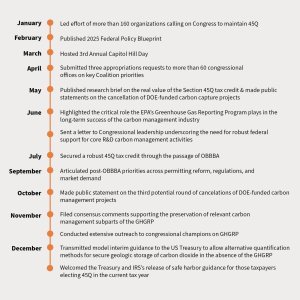
Reflecting on 2025, the Carbon Capture Coalition has prepared a summary of our 2025 victories, progress, and work to build the necessary policy framework for the nationwide deployment of carbon management technologies.
Fourth-ever Roadmap for Carbon Management Deployment Released
In early 2025, the Coalition published its fourth iteration of the Federal Policy Blueprint, a consensus-based road map developed by our diverse membership to guide the federal action needed to enable economywide deployment of carbon management technologies. It outlines common-sense policy, regulatory, and implementation recommendations to address inflationary pressures, improve project permitting, expand markets, and support next-generation technologies.
45Q Secured and Strengthened
The Coalition played a central role in securing the preservation and enhancement of the federal Section 45Q tax credit through the One Big Beautiful Bill Act (OBBBA). Thanks to sustained education and engagement with congressional champions and House and Senate leadership, the legislation preserves this mission-critical market signal for the deployment of carbon management technologies. Importantly, it maintains the ability to elect transferability for the lifetime of the credit, and creates long-sought parity between credit levels for carbon utilization and geologic storage.
These developments come at a pivotal moment, as the Coalition highlighted throughout 2025 the impacts inflationary pressures have had on project economics since the credit’s last increase. With raw materials, labor, and capital costs rising sharply in recent years, and the real value of 45Q eroding as a result, these improvements position the credit for more substantial long-term effectiveness. The Coalition remains optimistic and firmly committed to ensuring that 45Q continues to serve as a strong, predictable market signal, enabling the broad deployment of carbon management technologies across the US economy.
Advancing Alternative Compliance Mechanisms for Electing the 45Q Tax Credit
In 2025, EPA Administrator Zeldin announced that the EPA would propose repealing the Greenhouse Gas Reporting Program (GHGRP), which would eliminate greenhouse gas (GHG) emissions reporting under 41 subparts in the program, including those relevant to carbon capture and storage technologies.
The GHGRP and 45Q are intrinsically linked, and the most immediate effect on the carbon management industry of repealing the GHGRP would be to immediately block taxpayers’ ability to claim 45Q. In November, the Coalition submitted comments to the EPA, recommending that the EPA retain relevant subparts of the GHGRP or, at a minimum, delay the implementation of the repeal of Subpart RR until an alternative, commercially viable 45Q compliance mechanism is in place.
To that end, the Coalition also worked to communicate to the administration and policymakers how the GHGRP serves as the regulatory backbone of the federal Section 45Q tax credit, underpinning the integrity, transparency, and accountability of the program. In early December, the Coalition endorsed and transmitted interim model guidance to the US Department of the Treasury (Treasury) and the Internal Revenue Service (IRS) that would allow for taxpayers to continue relying on existing reporting mechanisms for claiming the 45Q tax credit until a long-term solution is identified.
In December, Treasury and IRS announced a safe harbor mechanism for taxpayers who capture and store carbon in dedicated saline geologic formations, thereby enabling a path forward for the continued election of the 45Q tax credit in 2025. Under this interim guidance, taxpayers using Subpart RR to substantiate volumes of CO2 stored for the purposes of enhanced oil recovery (EOR) must rely on alternative compliance methods recognized by Treasury, namely the International Standards Organization (ISO) standard for EOR.
In 2026, we will work with Congress and the administration to craft long-term solutions that allow all carbon management and geologic storage projects to continue being responsible stewards of taxpayer dollars, even in the event of the GHGRP’s possible absence.
Defending Congressionally Appropriated Carbon Management Demonstration Programs
In 2025, the DOE cancelled more than $7.5 billion in projects awarded under the bipartisan Infrastructure Investments and Jobs Act (IIJA), with 55 of those projects being relevant to carbon management. Additionally, in October, a third potential tranche of project cancellations was leaked to press, but to date, no additional cancellations have been made.
Throughout the year, the Coalition has sounded the alarm on how the cancellation of these lawfully awarded projects threatens billions of dollars in private investments pledged in every region of the country, risking high-quality American jobs, and our ability to lead the globe in technology innovation. Not only do these cancellations risk the significant economic benefits these projects were poised to provide, but they also undermine robust bipartisan congressional support and action aimed at ensuring America wins the global race in developing and deploying these technologies.
While the US is still arguably the leader in global deployment of carbon management technologies, with more than 270 announced projects in various stages of development, the cancellation of awarded demonstration projects cede US leadership to other nations, including China, Canada and members of the EU, that have made strategic investments in carbon management technologies.
Looking Forward to 2026
The Coalition spent 2025 communicating the value of carbon management technologies to Republicans and Democrats alike, highlighting the role this suite of technologies must play in supporting domestic energy production, meeting surging demand for clean, firm power, providing cleaner energy and industrial products to our trading partners, and creating family-sustaining jobs for regional economies across the US.
Now that 45Q is secured, the Coalition must advance common-sense policies to ensure the nationwide deployment of these essential technologies. We know that managing carbon emissions through carbon management technologies aligns closely with the administration’s goals to provide abundant, reliable, and affordable energy supplies, while maintaining and creating good American jobs in industries our economy relies on.
In 2026, the Coalition will focus on the highest priority near-term steps that can unlock additional carbon management deployment in the next decade, including targeted changes to the current project permitting regime, shoring up and advancing the necessary regulatory framework for carbon management, and building frameworks for market mechanisms that will drive demand for this suite of essential technologies.
###
The Carbon Capture Coalition (the Coalition) is a nonpartisan collaboration of more than 100 companies, labor unions, and conservation and environmental policy organizations. Coalition members work together to lay the groundwork for the necessary portfolio of federal policies to enable nationwide, commercial-scale deployment of carbon management technologies.